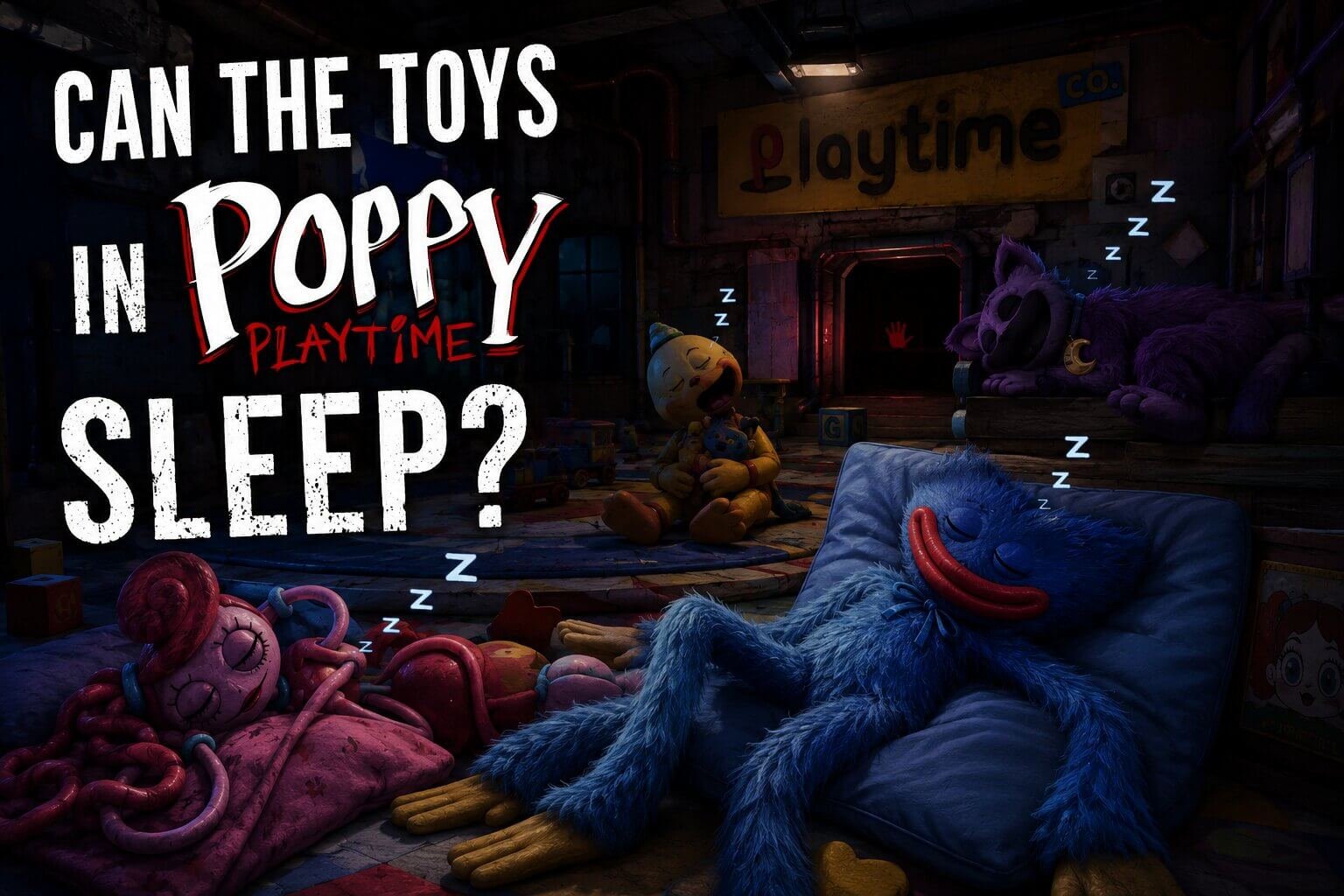
The world of Poppy Playtime is filled with mystery, horror, and countless questions about the living toys that roam the abandoned Playtime Co. factory. One of the most interesting questions fans often ask is: Can the toys in Poppy Playtime sleep?
At first glance, the answer may seem simple. Toys are not supposed to be alive, so they shouldn’t need sleep. However, the creatures found throughout the Poppy Playtime series are far from ordinary toys. They are living beings created through twisted experiments, making the question much more complicated.
In this article, we’ll explore the lore of Poppy Playtime, examine how the experiments work, and discuss whether characters like Huggy Wuggy, CatNap, Mommy Long Legs, and other toys may actually need sleep.
Understanding the Living Toys of Poppy Playtime
Before we can answer whether the toys sleep, we need to understand what they really are.
The monsters in Poppy Playtime are not simple stuffed animals or plastic figures brought to life through magic. According to the game’s lore, many of the larger creatures are the result of Playtime Co.’s secret experiments.
The Bigger Bodies Initiative
One of the most important projects in the game’s story is the Bigger Bodies Initiative.
This program involved transforming human subjects into living toys. Instead of creating robotic machines, Playtime Co. combined biological materials with toy-like bodies.
As a result, characters such as Huggy Wuggy and Mommy Long Legs possess:
- Intelligence
- Emotions
- Instincts
- Memory
- Physical needs
Because these creatures contain living biological components, they may share some of the same requirements as humans and animals.
That includes the possibility of needing sleep.
Evidence That Toys Can Rest
Throughout the games, players occasionally encounter toys that appear inactive for long periods.
Huggy Wuggy’s Long Periods of Inactivity
Before the events of Chapter 1, Huggy Wuggy spends years inside the factory.
Yet he does not constantly chase people through the halls.
This suggests that he spends much of his time:
- Hiding
- Conserving energy
- Remaining dormant
While dormancy is not exactly sleep, it is similar in many ways.
Many animals enter periods of low activity to preserve energy, especially when food is scarce.
CatNap’s Connection to Sleep
Perhaps the strongest evidence comes from CatNap.
Introduced in Chapter 3, CatNap is heavily associated with sleep.
His name alone suggests sleeping behavior, but there is much more.
CatNap releases the mysterious Red Smoke, which causes drowsiness, hallucinations, and unconsciousness.
Throughout the story, CatNap is connected to dreams, rest, and sleep-related themes.
Does CatNap Sleep Himself?
The game never directly shows CatNap sleeping.
However, his design and behavior strongly suggest that he understands sleep and possibly experiences it.
If CatNap were completely incapable of sleep, it would be strange for Playtime Co. to create such a strong connection between his character and sleeping.
Biological Creatures Usually Need Sleep
Another clue comes from real-world biology.
Scientists believe nearly every animal needs some form of rest.
Sleep helps with:
- Memory processing
- Tissue repair
- Energy restoration
- Brain function
Since many Poppy Playtime experiments contain living tissue and functioning organs, it would make sense that they also require periods of recovery.
The Experiments Show Human Traits
Many toys display behaviors that suggest human consciousness.
Examples include:
Mommy Long Legs
Mommy Long Legs demonstrates:
- Anger
- Fear
- Sadness
- Strategic thinking
These are advanced mental functions.
A brain capable of experiencing these emotions would likely benefit from rest.
Poppy
Poppy speaks intelligently and remembers past events.
She can hold conversations, make plans, and manipulate situations.
These traits suggest a functioning mind rather than a simple toy program.
Doey the Doughman
One of the more sympathetic characters in later chapters, Doey exhibits emotions and decision-making abilities that resemble human behavior.
Like other experiments, his mental complexity suggests that some form of rest may be necessary.
Why We Rarely See Toys Sleeping
If the toys need sleep, why don’t players ever encounter them asleep?
There are several possible explanations.
The Story Focuses on Action
Most chapters take place during moments of danger.
The player explores the factory while monsters are active and searching for targets.
Sleeping creatures would not create much tension for a horror game.
As a result, the developers may simply choose not to show these moments.
Sleep Cycles Could Be Different
The experiments are not fully human.
Their sleep patterns may differ dramatically from ours.
Instead of sleeping for eight hours at night, they might:
- Sleep briefly
- Enter dormant states
- Rest only when necessary
This could explain why players rarely witness it.
The Toys Have Adapted
After years trapped inside the factory, the experiments may have evolved.
They could survive on very little rest compared to normal humans.
Many animals in nature can function with unusual sleep schedules, and the toys may have developed similar adaptations.
Could Some Toys Be Unable to Sleep?
Not every toy in Poppy Playtime is the same.
The factory contains many different types of creations.
Smaller Mascot Toys
Regular toy products sold to customers may not need sleep at all.
If they are simply machines or ordinary toys, they have no biological requirement for rest.
Experimental Subjects
The larger monsters are a different story.
Characters such as:
- Huggy Wuggy
- Kissy Missy
- Mommy Long Legs
- CatNap
- Boxy Boo
appear to contain living biological elements.
These creatures are the most likely candidates for needing sleep.
The Horror of Never Sleeping
An interesting theory among fans is that some experiments may actually be unable to sleep.
Imagine being trapped inside a toy body for years without proper rest.
This could explain why many creatures appear unstable or aggressive.
Sleep deprivation in humans can cause:
- Hallucinations
- Irritability
- Poor judgment
- Emotional instability
If certain experiments lost the ability to sleep, their mental state could deteriorate over time.
This idea fits well with the dark themes of Poppy Playtime.
What the Lore Suggests
Although the games never provide a direct answer, the available evidence points toward a reasonable conclusion.
The larger experimental toys are not ordinary toys.
They possess:
- Living tissue
- Human-like intelligence
- Emotions
- Biological functions
Because of these traits, it is highly likely that many of them require some form of sleep, rest, or dormancy.
The exact mechanics may differ from human sleep, but complete sleeplessness seems unlikely for creatures with such advanced biological systems.
Final Thoughts
So, can the toys in Poppy Playtime sleep?
Based on the lore, the answer is probably yes—at least for the larger experimental toys.
Characters like Huggy Wuggy, Mommy Long Legs, CatNap, and other Bigger Bodies experiments appear to be living organisms rather than simple toys. Their biological nature suggests they need some form of rest to maintain their physical and mental functions.
However, the Poppy Playtime universe remains full of secrets. Until future chapters provide a definitive answer, the question remains one of the many fascinating mysteries hidden within Playtime Co.’s terrifying factory.
For now, fans can only speculate whether the monsters stalking the dark hallways eventually curl up somewhere in the factory and go to sleep—or whether they spend every moment waiting for their next victim.


Leave A Comment