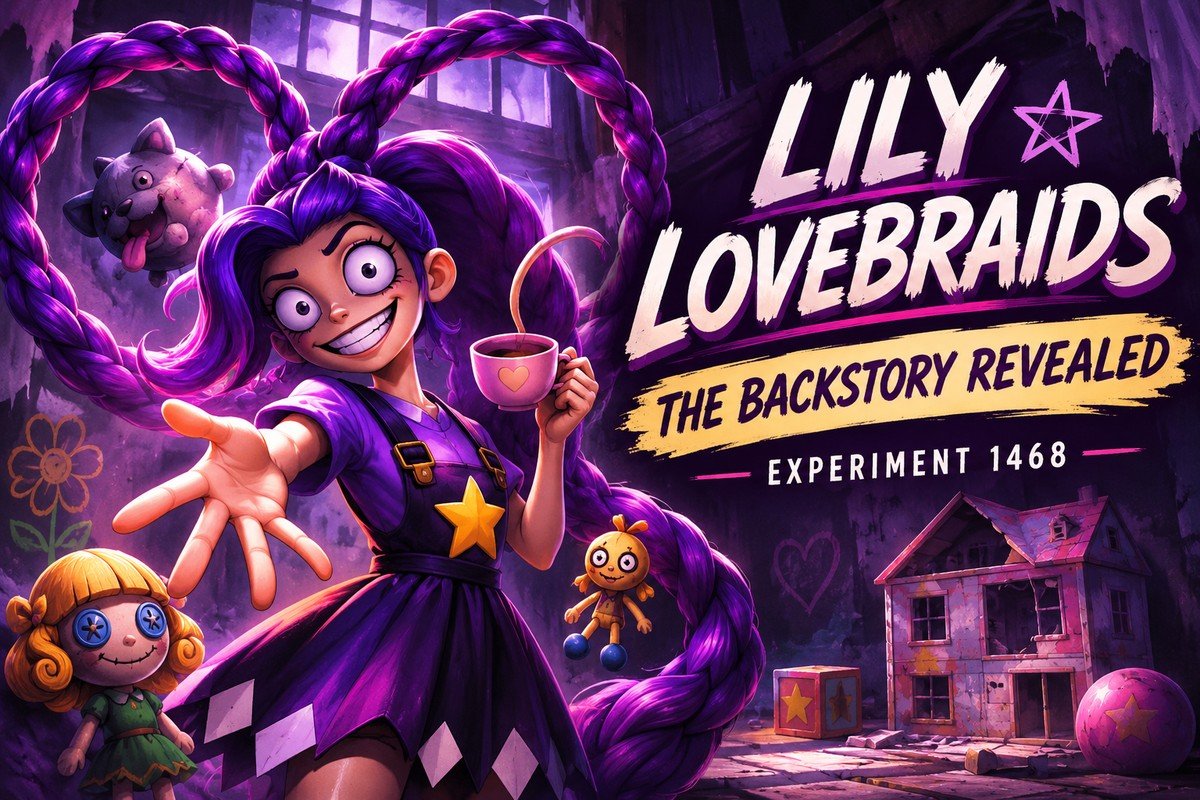
There is something especially unsettling about a character who wants to be your friend but cannot understand why you might want to leave. Lily Lovebraids has that contradiction built into her story. With her extravagant purple braids and cheerful doll persona, she looks like a character created for a colorful toy commercial. In the shadows of Playtime Co., though, the same bright personality becomes a warning sign.
Fans have asked about Lily Lovebraids’ backstory, her experiment number, her memories, and what happened to her before Chapter 5. Some answers are confirmed by the creator. Others remain deliberate gaps. Here is the difference—and why those gaps make her one of the chapter’s most memorable figures.
Who Was Lily Lovebraids Before the Horror?
Before she became a name in the factory’s experiment records, Lily Lovebraids was a commercial toy character. MOB Entertainment’s official character page describes the doll as a product of the 1980s: outgoing, expressive, and enthusiastic about changing her appearance. This was a character meant to sell imagination. She could reinvent herself, dye her hair, and confidently wear an unusual outfit because individuality was the point of the toy.
It is a smart piece of horror-world building. The original pitch is harmless—even charming. But the game’s world has repeatedly shown us how Playtime Co. turns comforting products into the public face of something inhuman. The more cheerful the brand description sounds, the more uncomfortable the next reveal feels.
Why her purple braids matter
Lily’s oversized braids are not simply a design flourish. They make her instantly recognizable, even in a chaotic scene with other creatures or props. They also connect her appearance to the promise of endless self-expression that defines her marketed persona. When fans sketch her, cosplay as her, or compare Lily Lovebraids plush designs, the braids are usually the feature they want to get right first.
That visual identity is consistent. Her personal history, however, is much less stable.
Experiment 1468: The Confirmed Identity
Lily is Experiment 1468. MOB Entertainment labels her that way in its official profile, so this is one of the rare parts of the story that does not require speculation. For a focused explanation of the number and how to check it, see our Experiment 1468 FAQ.
What matters most is not the digits. The official description explains that Lily no longer remembers having been anything other than a toy. In other words, the original life behind the experiment has become inaccessible to her. That is a chilling premise because memory is one of the things people rely on to explain who they are.
Is she still the same person she once was? Does the toy persona act as a replacement, a defense, or something imposed on her by others? Those are reasonable questions to ask. They are interpretations, however, not answers the official page spells out in full.

What Happened to Lily in the Lullaby Room?
The official profile says that the Prototype locked Lily in a Lullaby Room for months. That detail matters for two reasons. First, it establishes a connection between Lily’s suffering and the character who dominates the wider Chapter 5 conflict. Second, it tells us that her situation was not a momentary misunderstanding. The description emphasizes extended isolation.
The profile also asks why nobody comes to see her in her manor. That absence fits a character whose need for company has become a dangerous obsession. Someone who has spent so long alone may cling to the idea of friendship even when the other person is desperate to escape.
What the official profile does not explain
It does not give us a complete day-by-day timeline, a full medical file, or a definitive account of every person involved in Lily’s earlier life. It does not establish a precise date for her conversion just because her experiment ID is known. Fans should be careful not to turn dramatic theories into “facts” simply because the story leaves those spaces blank.
This is where the writing can be more interesting than an invented reveal. The scary part is the uncertainty. Lily has a manufactured personality and an incomplete past, and the player has to face what that combination has become.
Why Does Lily Want Friends to Stay?
The toy’s promise has turned into a trap
The commercial version of Lily wants to meet people and express herself. Experiment 1468, according to the official description, wants new friends but does not like letting them go. That is a brilliantly simple reversal. A sentence that would sound cute in a toy advertisement becomes threatening once you imagine it spoken by someone who has lost her memory and freedom.
This does not require us to invent a secret villain speech. The core character concept already does the work. The game builds dread around familiar, childlike activities while reminding the player that the rules of this place are not normal.
Why the tea-time encounters feel different
Official Chapter 5 patch notes reference Lily’s chase sequences and a section called Tea Time, confirming that the character’s story also has a direct gameplay expression. A doll who offers companionship in one moment and becomes part of a dangerous encounter in another fits the chapter’s larger theme of mistrust. The cheerful setting is not a guarantee of safety.
When interpreting these sequences, it helps to separate the player experience from the lore. A chase is a fact about gameplay. An exact psychological diagnosis of Lily—or a detailed theory about what she remembers during that chase—requires more evidence than a short animation or a fan screenshot can provide.
How Is Lily Connected to the Prototype?
The official page directly connects the Prototype to Lily’s isolation. That is enough to establish a meaningful part of their relationship. But fans often go further, arguing that every choice Lily makes must be controlled by the Prototype. The source does not justify that broader claim on its own.
In Chapter 5: Broken Things, the Prototype is framed as the central threat in a deeper section of the factory. Lily’s own story provides a disturbing side of that bigger conflict: instead of treating monsters only as obstacles, the narrative shows what they may have endured.
For a wider look at Experiment 1006, read our existing Prototype identity guide. For an overview of the chapter’s cast, visit the Five Star Toy Chapter 5 character guide.
Theories About Lily’s Human Identity
A popular temptation is to assign a definite human name or backstory to every experiment. Fans can build fascinating theories from character names, tapes, and isolated references, but a theory needs to be presented as a theory. The official Lily profile confirms memory loss and the Experiment 1468 designation; it does not provide a complete verified biography of her life before becoming a toy.
If you see a post claiming to know exactly who Lily used to be, ask whether it cites a game document showing her name and her experiment ID together. If the evidence is a guess built on similarities or timing, that can still be fun to discuss—but it should not be introduced to new readers as established canon.
Frequently Asked Questions About Lily Lovebraids
What is Lily Lovebraids’ experiment number?
1468. This comes from MOB Entertainment’s official character description. Read the full experiment-number explanation if you want the evidence in one place.
Does Lily remember being human?
Her official profile says she does not remember being anything other than a toy. That tells us about her current memory, not every detail of her original identity.
Why was she locked in a Lullaby Room?
The official description confirms that the Prototype kept her there for months. It does not give a fully documented motive, so more elaborate explanations remain speculative.
Is Lily the main villain of Chapter 5?
Lily is a major source of danger, but the chapter’s larger conflict centers on confronting the Prototype. The distinction between a terrifying encounter and the overarching antagonist matters.
Can you buy a Lily Lovebraids plush?
Five Star Toy lists a 25 cm Lily Lovebraids plush. It is a fan-made, non-officially-licensed collectible, so review the product page carefully. Our Chapter 5 plush comparison guide also compares Lily with Chum and the Prototype.
Final Thoughts: A Character Built From Missing Pieces
What makes Lily memorable is not a single twist that explains everything. It is the contrast between the doll she was marketed as and the person she can no longer remember being. Experiment 1468 has a number, a famous look, and an unsettling need for friendship, but large parts of her past remain missing.
That uncertainty is worth respecting. A good Poppy Playtime fan theory starts with what the game and creators reveal, then asks a question. It does not skip straight to a sensational answer. And with Lily Lovebraids, the confirmed story is already dark enough.
Primary references: Lily Lovebraids official profile, MOB Entertainment Chapter 5 overview, and MOB Entertainment Chapter 5 patch notes.



Leave A Comment